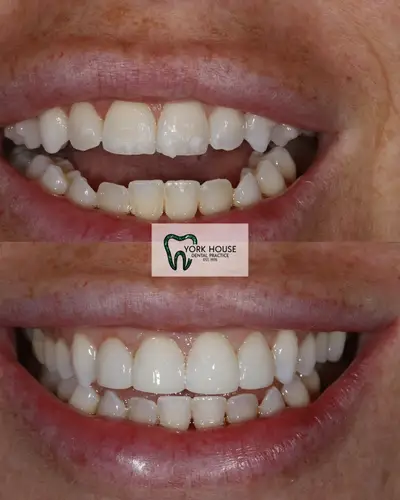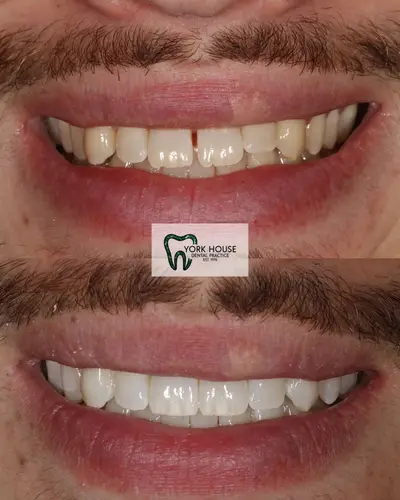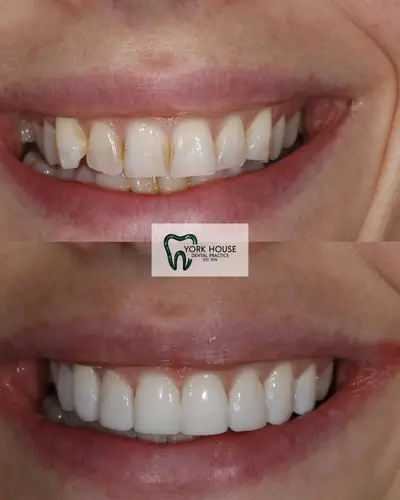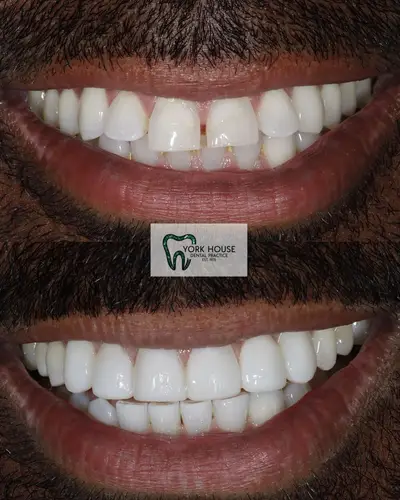


Most Requested
Single implant
From£2,500
Includes implant & crown
Replace missing or failing teeth with dental implants in West Byfleet at York House Dental Practice. We also provide dental implants in Surrey for patients from Woking, Weybridge, Byfleet and nearby — a fixed, long-term alternative to dentures and bridges, placed by GDC-registered implant dentists. Our team has placed more than 5,000 implants, with success rates typically around 98% in suitable, well-maintained cases.

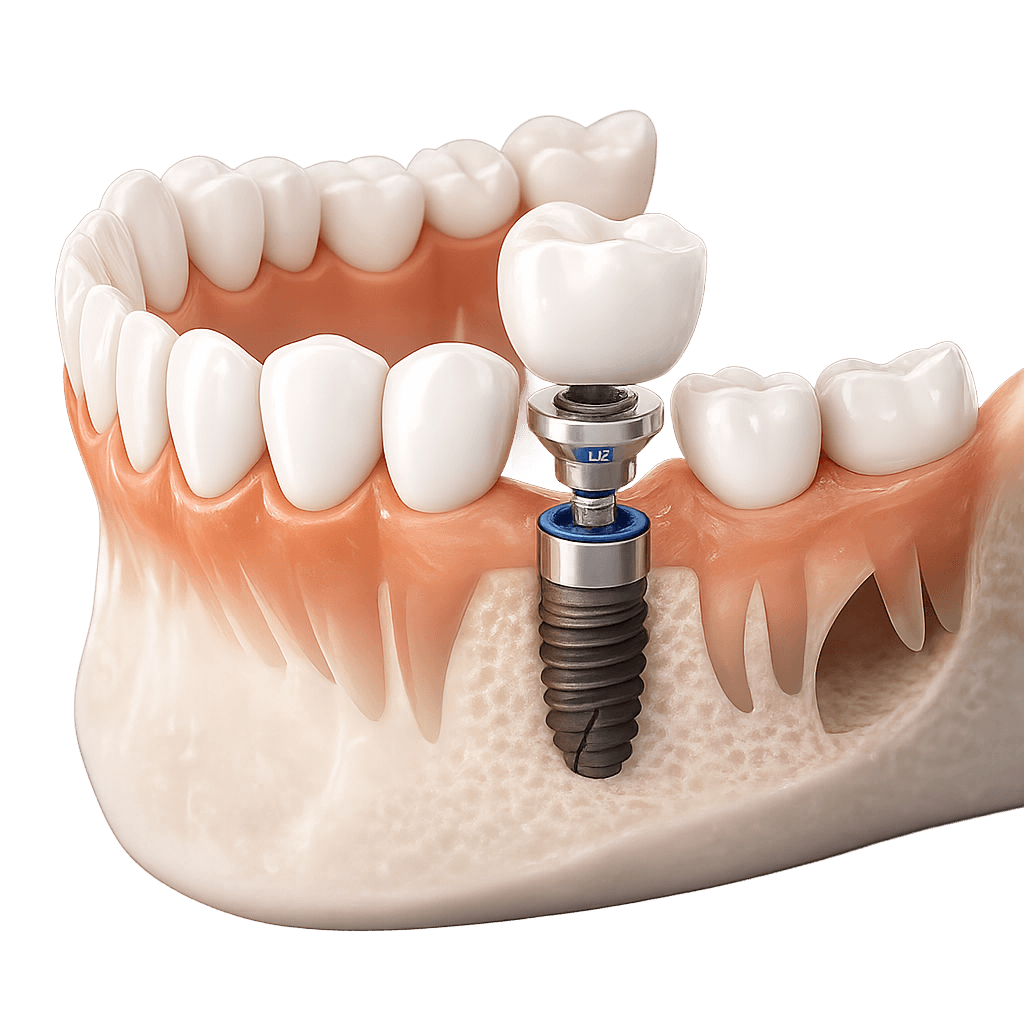
A dental implant is a small titanium post placed into the jawbone, where it takes over the job of a natural tooth root. Once the bone has bonded to its surface — a process called osseointegration — a custom crown, bridge or denture is fixed on top. The result feels and functions far closer to a natural tooth than anything that simply rests on the gums.
The part patients tend not to expect is what happens beneath the surface. When a tooth is lost, the bone that held it begins to shrink, most noticeably in the first year, which is why long-standing gaps can change the shape of the face and make dentures progressively looser. An implant loads that bone as you chew, and that stimulation is what helps preserve it. It is also why we rarely advise waiting years before discussing implants.
At our Lavender Park Road practice in West Byfleet, implant treatment is planned around a 3D CBCT scan — included at no cost for implant patients — so we can see bone volume, nerve position and sinus anatomy before anything is committed to. Patients travel to us from across Surrey, including Woking, Weybridge, Byfleet, Addlestone, Chertsey and Cobham, and we plan appointment timings around that where we can. If you need a full arch replacing, see ourAll-on-4 dental implantspage.
What implants do well — and why our dentists recommend them in some situations but not others.
A conventional bridge relies on the teeth either side, and preparing them means permanently removing healthy enamel. An implant is self-supporting, so neighbouring teeth are left exactly as they are.
Bone that is no longer being loaded gradually resorbs. An implant transmits chewing forces into the jaw much as a natural root does, which helps maintain bone volume and the facial support that comes with it.
Most patients tell us the difference is clearest with harder foods — apples, crusty bread, steak. A fixed implant restoration is considerably more stable under load than a removable denture, and there is no adhesive to think about.
For patients who have worn a partial denture, this is often the change they mention first. Implant restorations stay in place, are cleaned in the mouth, and do not need to be removed socially or at mealtimes.
Titanium implants have been used and studied for decades, and outcomes are among the best recorded in dentistry — typically around 98% success in suitable patients who maintain them.
Brushing, interdental cleaning and regular hygiene visits — the same habits that protect natural teeth. Implants cannot decay, but the gum and bone around them can become inflamed if plaque is left, so upkeep genuinely matters.
From your first consultation in West Byfleet to your final crown fitting — every stage is carefully planned, fully explained, and built around your comfort.
We examine the site, check the health of the surrounding teeth and gums, and talk through what you want to achieve. Medical history matters here — diabetes control, smoking and certain medications all influence healing, so we ask about them early.
A cone beam CT scan maps bone height, width and density, plus the position of nerves and sinuses. It takes seconds and is free for implant patients. Occasionally it shows that a graft or sinus lift is needed; far better to know now than mid-treatment.
You receive a plan setting out the number of implants, any preparatory work, the type of restoration, the expected timeline and the full cost. Nothing is booked until you have had time to read it and ask questions.
Placement is carried out under local anaesthetic and is usually more straightforward than patients anticipate — often comparable to having a tooth removed. A single implant typically takes under an hour. You go home the same day with clear written aftercare.
The implant integrates with the bone over roughly three to six months, depending on the site and whether grafting was involved. A temporary option can often bridge the gap. Once integration is confirmed, the final crown, bridge or denture is fitted.
We review the implant after fitting and then monitor it alongside your routine check-ups and hygiene appointments. Early signs of gum inflammation around an implant are easy to treat and much harder to reverse if left.
One tooth, several teeth, or a full arch — the right option depends on how much bone you have, how many teeth are missing, and what you want day to day. Your dentist will talk you through the trade-offs of each, including when a dental bridge ordenture would be the more conservative choice.
One implant, one crown. The usual choice for a single gap where the neighbouring teeth are sound — and the option that avoids cutting into those teeth for a bridge. From £2,500, including the implant and crown.
Two or more implants supporting a bridge across several missing teeth. You need fewer implants than teeth being replaced, which often makes this more cost-effective than restoring each gap individually, without relying on natural teeth for anchorage.
A fixed full-arch bridge supported by four to six implants, sometimes referred to as All-on-4 or Teeth-in-a-Day. Suited to patients who have lost most of an arch or struggle with a loose lower denture. Planning is more involved, and CBCT findings determine whether it is realistic.
All-on-4 dental implants in West ByfleetNot sure which option is right for you?
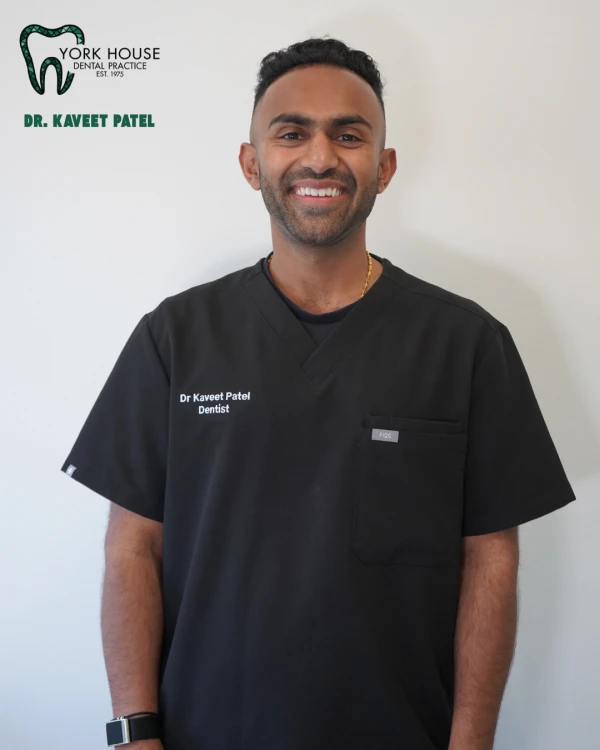
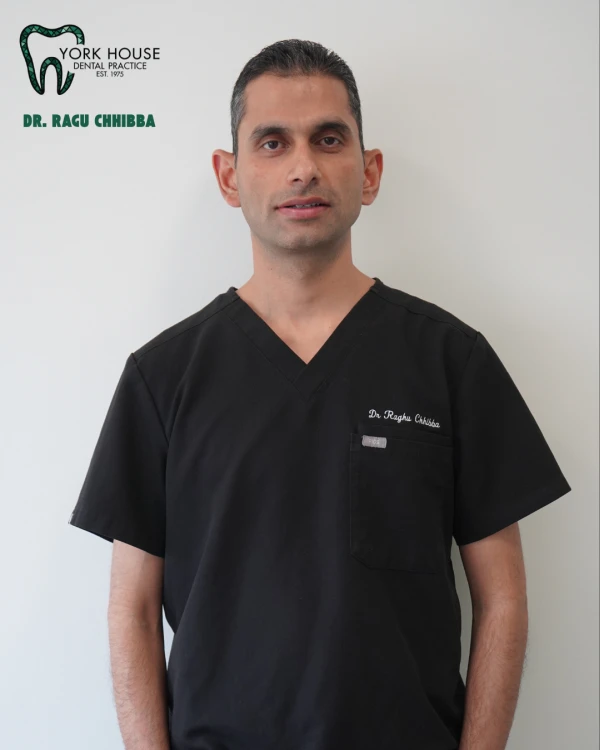
Book a consultationYour treatment is planned and carried out by one of ourGDC-registered implant dentists — Dr Kaveet Patel, Dr Marta Amin or Dr Raghu Chhibba — who between them have placed more than 5,000 implants for patients across West Byfleet and the wider Surrey area. You will meet the dentist who will be treating you at your first consultation, not a coordinator.
Dr Kaveet Patel, Dr Marta Amin and Dr Raghu Chhibba are GDC-registered with training in implantology and restorative dentistry, and more than 5,000 implants placed between them.
A third-generation, family-run practice on Lavender Park Road. Many of our implant patients were treated here long before their implant — and their records go back just as far.
Implant patients receive a 3D cone beam CT scan at no cost. It is what allows us to say with confidence whether a site is suitable, or whether grafting should be planned in from the start.
Every plan is itemised before treatment begins, including any grafting and the final restoration. Finance, including 0% options, is available subject to status.
A single dental implant in West Byfleet starts from £2,500, including the implant and crown — the same from-price we quote for dental implants in Surrey. Your final figure depends on how many implants are needed, whether a bone graft or sinus lift is required first, and the type of restoration — a single crown, an implant bridge or afull-arch solution. We confirm all of this in an itemised written quote after your CBCT scan, before you commit to anything. Monthly payments are explained on ourdental finance page.
From£2,500
Includes implant & crown
Treatment can be spread over manageable monthly payments through a regulated finance provider, with 0% options on selected plans, subject to status. Ask our team and we will run through the figures with you.
No obligation quote
Most healthy adults who have finished growing can be considered for implants, but suitability is decided by what we see on the scan and in your mouth — not by age. The consultation exists to give you a straight answer, including when that answer is “not yet” or “there is a better option for you”.
Some situations need work beforehand, and a few call for a different plan altogether. Active gum disease is treated first, because an implant placed into inflamed tissue is far more likely to fail. Smoking measurably increases that risk, and we will talk frankly about it. Uncontrolled diabetes, certain bone medications, a history of head and neck radiotherapy, and heavy unmanaged grinding all need careful consideration. Where bone is limited, grafting or a sinus lift can often create it — and where implants are not appropriate, we will say so and discussdentures orcrowns andbridges instead. Read who is suitable for dental implantsfor more on each of these factors.
Implant surgery is well established and complications are uncommon, but they are not impossible and you should know about them before consenting. Swelling, bruising and tenderness for a few days are normal and usually settle with over-the-counter pain relief. Less commonly, an implant fails to integrate with the bone and needs to be removed and replaced — most often in smokers, patients with untreated gum disease, or where healing is compromised. Infection, and altered sensation from proximity to a nerve in the lower jaw, are rarer still; the CBCT scan is precisely how we plan to avoid them. Over the longer term, the main risk is peri-implantitis, an inflammatory condition around the implant caused by plaque, which is why ongoinghygiene care is part of the treatment rather than an optional extra. Our clinicians areGDC-registered, and we will talk through these risks in writing before you consent.
Common questions about dental implants in West Byfleet anddental implants in Surrey, answered from our Lavender Park Road practice. You may also find our guides onimplant cost andhow long implants lastuseful. Do not see yours? Call 01932 348864 orbook a consultation.
A straightforward single implant usually takes three to six months from placement to final crown, and most of that is healing time rather than time in the chair. You would typically attend for a consultation and CBCT scan, a placement appointment, then one or two restorative visits. If a tooth needs removing first, or a bone graft is required, add roughly three to six months. You will have a dated timeline in your written plan before you start.
The placement itself is carried out under local anaesthetic, so you should feel pressure but not pain. Most patients tell us afterwards that it was more comfortable than they expected — often comparable to a tooth extraction. Expect some tenderness, and possibly swelling or bruising, for two to four days; over-the-counter pain relief is usually enough. If discomfort worsens after day three rather than improving, phone us on 01932 348864.
The implant itself is designed to be a long-term solution and frequently lasts 25 years or more; many remain in place for life. The crown or bridge attached to it is a wearing part and may need replacing at some stage, much like any restoration. Longevity depends heavily on daily cleaning, hygiene visits and whether you smoke — these factors influence outcomes more than the brand of implant used.
There is no upper age limit. We assess bone quality, gum health, general health and medications rather than date of birth, and we regularly treat patients in their seventies and eighties. There is a lower limit — the jaw must have finished growing, generally the late teens.
A single dental implant in West Byfleet starts from £2,500 at York House Dental Practice, including both the implant and the crown. Multiple implants and full-arch restorations are quoted individually after a CBCT scan, and any grafting or sinus lift is shown as a separate line. 0% finance is available on selected plans, subject to status.
At York House Dental Practice in West Byfleet, a single dental implant starts from £2,500, including both the implant and the crown. That is our private fee for dental implants in Surrey for a straightforward single-tooth case. Multiple implants and full-arch restorations are quoted individually after a CBCT scan, and any grafting or sinus lift is shown as a separate line. 0% finance is available on selected plans, subject to status.
York House Dental Practice provides dental implants in Surrey from our clinic on Lavender Park Road, West Byfleet. Patients travel to us from Woking, Weybridge, Byfleet, Addlestone, Chertsey and Cobham. Treatment is planned with a free 3D CBCT scan and carried out by GDC-registered implant dentists. Call 01932 348864 and we will group appointments around your travel where the clinical sequence allows it.
Yes. Every implant patient at York House Dental Practice in West Byfleet receives a 3D cone beam CT scan at no extra cost. It maps bone height, width and density, plus the position of nerves and sinuses, so we can tell you at the consultation whether the site is suitable or whether a graft or sinus lift should be planned in. We will always say if a denture or bridge would be more appropriate before you commit to surgery.
Yes. We work with a regulated finance provider so treatment can be spread over monthly instalments, with 0% options available on selected plans, subject to status. Our team can show you the monthly figures for your specific plan before you decide.
This is common where a tooth has been missing for years, and it rarely rules implants out. Bone grafting rebuilds width or height at the site, and in the upper back jaw a sinus lift creates room beneath the sinus floor. Both add healing time — typically a few months — and cost to the plan. Your CBCT scan tells us at the consultation stage whether either is likely.
Smoking does not automatically exclude you, but it is the single biggest patient-controlled risk factor for implant failure, as it reduces blood flow and slows healing. We will discuss this honestly and usually ask you to stop, or at minimum pause, for a period before and after placement. Some cases we will decline until that happens — because placing an implant likely to fail serves nobody.
Not universally — they suit different situations. Compared with a denture, an implant is fixed, more stable when chewing and helps preserve bone that a denture does not. Compared with a bridge, an implant avoids permanently reducing the healthy teeth either side. Dentures and bridges remain sensible choices where bone is insufficient, where budget is tighter, or where a patient would rather avoid surgery. We will set out the realistic options for your mouth.
Brush twice daily, clean between the teeth every day with floss or interdental brushes, and keep to your hygienist appointments — usually every three to six months for implant patients. Implants cannot decay, but the gum and bone around them can become inflamed if plaque builds up, and that is the main cause of long-term implant problems. We show you the specific cleaning technique for your restoration when it is fitted.
It is a fixed bridge replacing an entire upper or lower arch, supported by four to six implants rather than one per tooth. It is often considered by patients with a loose lower denture or widespread tooth loss. Whether it is achievable depends on the bone available in specific parts of the jaw, which the CBCT scan shows clearly. Planning, appointments and cost are all greater than for a single implant.
Yes. We see implant patients from Woking, Weybridge, Byfleet, Addlestone, Chertsey and Cobham, and we group appointments where clinically sensible to reduce the number of trips. The practice is on Lavender Park Road, a short walk from West Byfleet station with parking nearby. Call 01932 348864 and we will work around your travel where the treatment allows it.
Still have questions?
Book a consultation at our Lavender Park Road practice and we will assess whether implants are right for you, carry out your CBCT scan free of charge, and put a clear itemised cost in writing. Patients travel to us from across Surrey — Woking, Weybridge, Byfleet, Addlestone, Chertsey and Cobham — and there is no obligation to proceed.
York House Dental Practice ·Lavender Park Road, West Byfleet, Surrey, KT14 6NDLast reviewed: by Dr Kaveet Patel, Principal Dentist
Rebuild, protect and restore the natural function and strength of your teeth.
Full-arch fixed teeth on four or more implants.
Custom porcelain caps to protect and strengthen damaged teeth.
Fixed tooth restorations that seamlessly bridge gaps.
Comfortable, natural-looking removable teeth solutions.
See the stunning results our patients achieve with our cosmetic dentistry treatments in West Byfleet, Surrey.